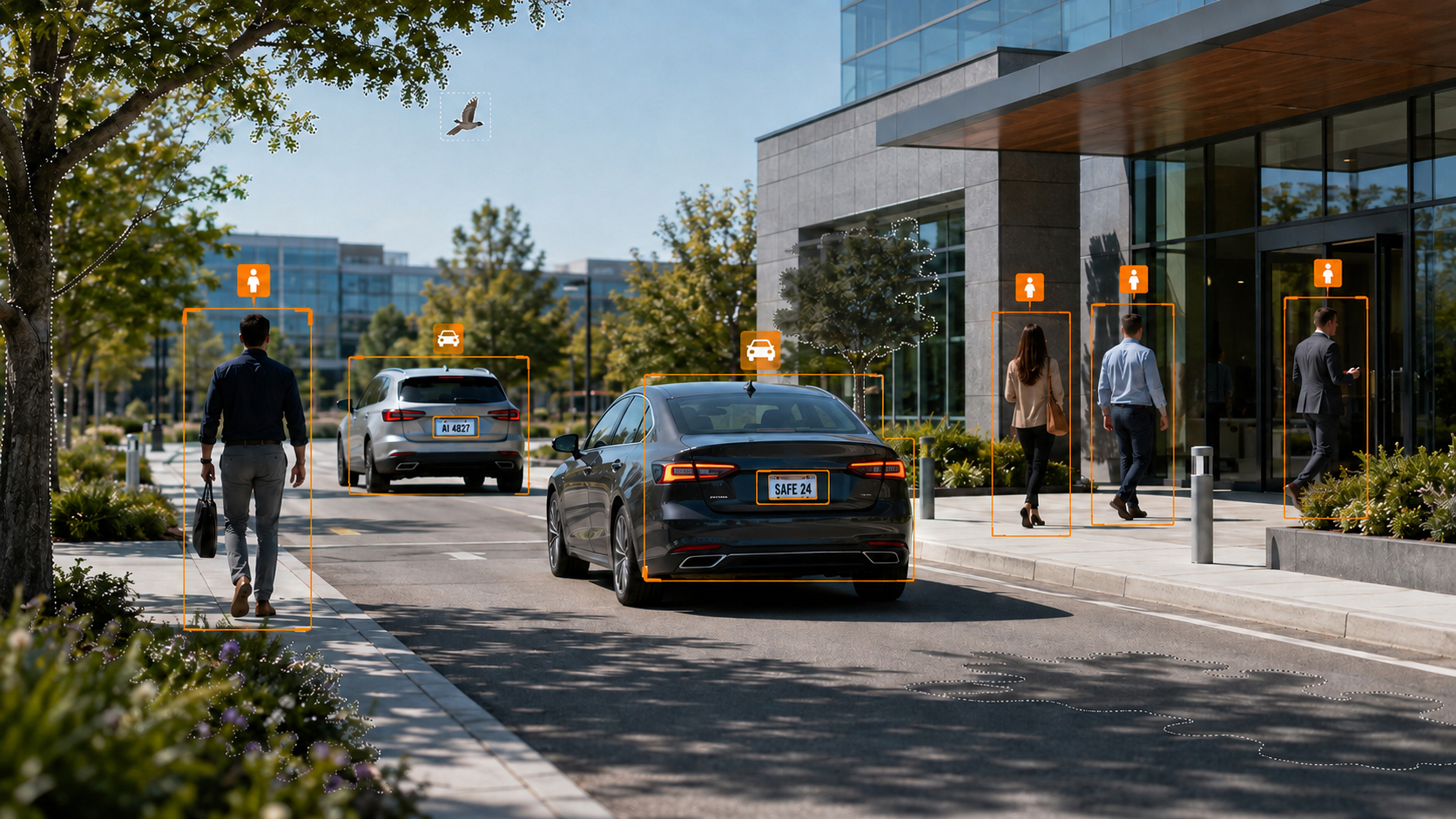



AI sees what you need it to see, reducing false notifications and shortening investigation time. |
For decades, security cameras primarily served as evidence-gathering tools. They recorded video so someone could review what happened after an incident. AI-powered security cameras change that model. By identifying important activity as it happens, they help organizations detect potential threats, investigate incidents faster and gain useful operational insights—all while reducing the burden on security personnel. What Makes a Security Camera “AI-Powered”?An AI-powered camera uses machine learning and video analytics to interpret what it sees. Traditional motion detection responds whenever pixels in an image change. This can produce alerts caused by rain, shadows, reflections, moving branches or other harmless activity. AI can go further by detecting and classifying specific objects, including:
This additional context helps the surveillance system distinguish meaningful events from background activity. Fewer False AlarmsReducing nuisance alerts is one of the most practical benefits of AI-powered surveillance. Instead of notifying users about every movement, an AI-enabled system can focus on relevant events. For example, it may ignore a tree moving in the wind but generate an alert when a person enters a restricted area. Fewer false alarms allow security teams to place greater confidence in the alerts they receive. Faster Threat DetectionAI-powered cameras can identify potential security events in real time, including:
When integrated with a video management system, these events can trigger notifications and help operators evaluate situations immediately. AI does not replace human judgment. It helps direct that judgment toward the events most likely to require attention. Faster Video InvestigationsReviewing recorded video can be one of the most time-consuming parts of an investigation. AI creates searchable metadata by identifying and classifying objects and events. Investigators can use criteria such as object type, location, time or direction of travel to narrow their search. Instead of watching hours of footage, a user may be able to locate relevant video within minutes. This can accelerate investigations and improve the organization’s ability to respond to security, safety and liability incidents. Greater Situational AwarenessAI-powered cameras can provide a clearer understanding of activity across a facility or multiple locations. Depending on the system and analytics available, organizations may gain visibility into:
These insights can help security teams recognize changing conditions and respond more effectively. Better Use of Security ResourcesSecurity departments often manage many cameras with limited personnel. No operator can watch every camera continuously and maintain the same level of attention. AI helps teams work more effectively by:
This allows personnel to concentrate on verification, decision-making and response. Operational Intelligence Beyond SecurityThe same video that supports security can also provide useful business intelligence. In retail environments, organizations may use analytics to understand customer traffic, monitor queues and evaluate store layouts. Warehouses can examine vehicle flow, loading-dock activity and process efficiency. Manufacturers may use video to support safety compliance, production oversight and workflow reviews. Schools and universities can monitor campus occupancy, visitor activity and perimeter conditions. These applications can increase the value of a surveillance system without requiring a separate sensor for every operational question. Scalable MonitoringAs an organization grows, manually monitoring hundreds or thousands of cameras becomes increasingly impractical. AI helps surveillance systems scale by automating the initial detection and classification of activity. This is especially valuable for:
Rather than treating every camera equally, the system can help operators focus on cameras where relevant events are occurring. The Advantages of Edge AIMany modern security cameras perform AI processing directly on the camera. This is known as edge AI. Analyzing video at the edge can provide:
Edge AI can also work with server-based analytics. The best approach depends on the organization’s infrastructure, applications and performance requirements. Planning a Successful AI DeploymentAI is powerful, but it is not automatic magic. Performance depends on the overall system design. Organizations should consider:
The most successful deployments begin with a defined problem—not simply a desire to “add AI.” Organizations should determine what they want to detect, how alerts will be verified and what actions personnel should take. How Digital Watchdog Can HelpDigital Watchdog provides AI-enabled surveillance solutions designed to turn video into useful, actionable intelligence. MEGApix® Ai cameras bring object detection and classification to the edge. DW Spectrum® IPVMS helps users manage video, events and investigations through an intuitive interface. Blackjack® Ai servers and appliances can add AI intelligence to virtually any existing video stream, support scalable recording, system management and advanced analytics across a wide range of applications. Metapix® AI transforms video into searchable data and enterprise-level dashboards. Integrated with the DW Spectrum IPVMS ecosystem, Metapix AI supports face, person, vehicle and license plate recognition, partial-text searches, watchlists, rules, notifications and traffic-analysis dashboards. Its hybrid architecture combines on-premises hardware with cloud-connected access, helping organizations expand their analytics capabilities while supporting different infrastructure and deployment requirements. Together, these technologies can help organizations:
AI-powered cameras represent an important evolution in video surveillance. They help organizations move beyond simply recording what happened toward understanding what is happening—and responding with greater speed, context and confidence. |