


AI should assist decision-making, not replace it.. |
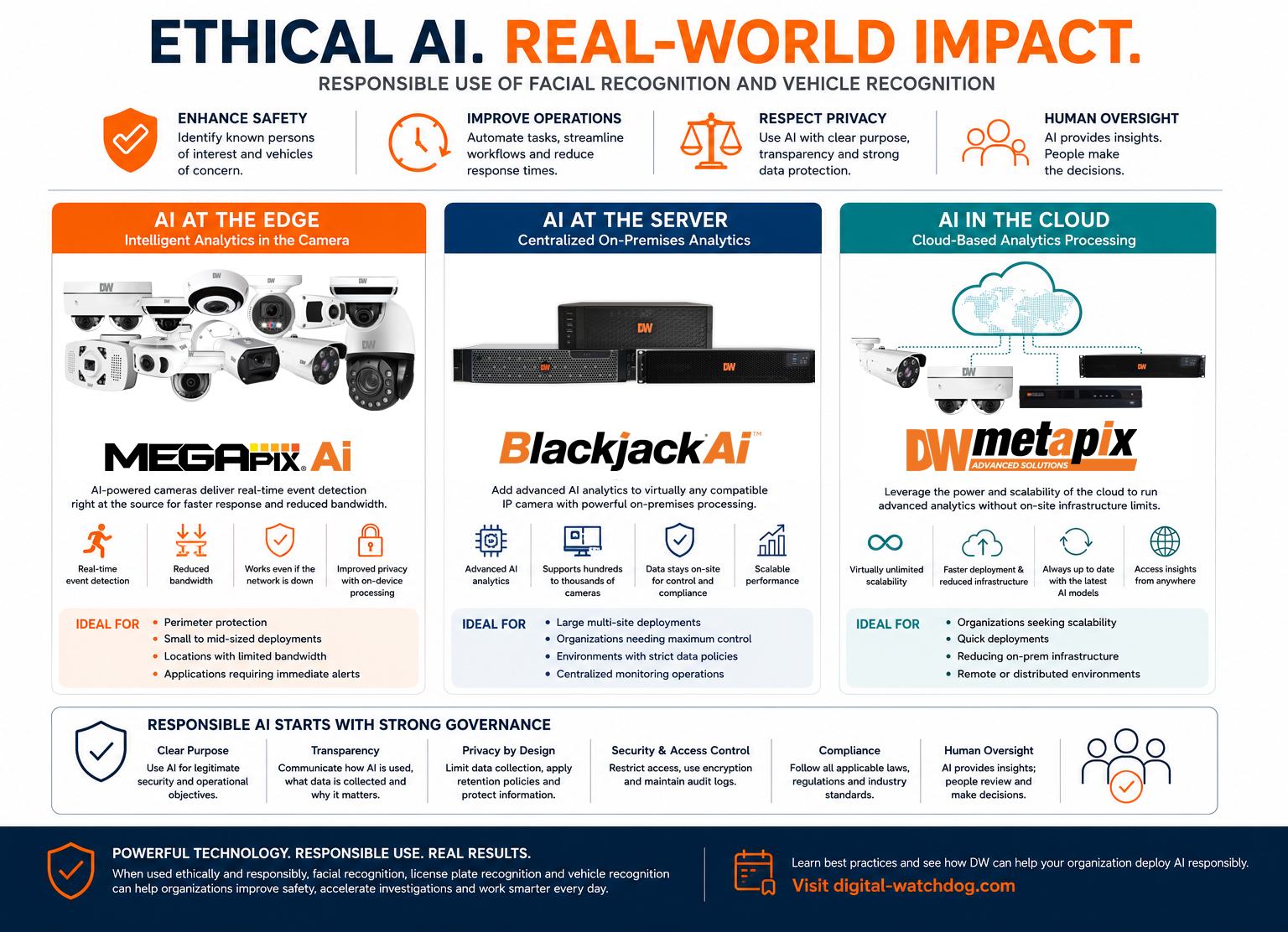
Artificial intelligence is changing what video surveillance can do. Facial recognition, license plate recognition and vehicle recognition can help organizations search video faster, identify persons or vehicles of interest and respond more efficiently to real security events. But these capabilities also carry responsibility. The question is not simply whether organizations can use AI. The better question is how they can use it appropriately, transparently and in alignment with applicable laws, internal policies and public expectations. AI Should Support Human JudgmentAI should assist decision-making, not replace it. Facial recognition and vehicle recognition can help reduce investigation time and surface relevant events more quickly. However, AI-generated matches should be reviewed by trained personnel before action is taken. A responsible “human-in-the-loop” approach helps reduce false positives, supports accountability and keeps final decisions in human hands. Facial Recognition Requires Strong GovernanceFacial recognition can be useful in carefully controlled environments, but it should be treated as a sensitive technology. Ethical uses may include secure facility access, restricted-area protection, post-incident investigation or locating a known person of concern when there is a legitimate safety or security purpose. Organizations considering facial recognition should define clear policies before deployment, including:
Facial recognition should not be deployed casually. It requires clear purpose, limited scope, documented procedures and human oversight. Vehicle Recognition and LPR Can Improve Security and OperationsVehicle recognition can identify vehicle characteristics such as type, color, make or model. License plate recognition, also known as LPR or ANPR, captures and reads plate numbers. These tools can support practical security and operational use cases, including:
Like facial recognition, vehicle and plate data should be handled responsibly, with defined retention rules, access controls and audit trails. Transparency Builds TrustOrganizations should be prepared to explain how AI is being used and why. That does not mean revealing sensitive security procedures. It does mean having clear internal policies and, where appropriate, communicating with employees, tenants, students, visitors or customers about the role of AI-enabled video surveillance. Trust improves when people understand that AI is being used for legitimate purposes, governed by policy and reviewed by accountable personnel. Privacy by DesignEthical AI begins with disciplined system design. Best practices include limiting data collection to legitimate business purposes, applying role-based permissions, using encryption, maintaining audit logs, enforcing retention policies and regularly reviewing system use. The goal should not be to collect the most information possible. The goal should be to collect only what is needed, protect it properly and use it responsibly. The Right AI Architecture MattersAI can be deployed in different parts of the video surveillance system. Some organizations need analytics at the camera for fast, local detection. Others need server-based analytics to add intelligence across many connected video streams. Some environments benefit from cloud-based analytics processing for scalability, flexibility and easier deployment. The right approach depends on the environment, security objectives, infrastructure, compliance requirements and long-term growth plans. How Digital Watchdog Can HelpDigital Watchdog gives organizations flexible ways to deploy AI analytics across the surveillance architecture. MEGApix Ai cameras provide AI at the edge, enabling intelligent analytics directly at the camera. BlackJack Ai servers and appliances provide AI at the server, allowing organizations to add analytics to connected video streams through centralized processing. Metapix servers and appliances support cloud-based analytics processing, giving organizations another path to scalable AI deployment. This flexible architecture helps customers choose where AI processing belongs: at the edge, at the server or through cloud-based analytics. That matters because responsible AI is not only about the analytic itself. It is also about deploying the right capability in the right place, with the right policies, oversight and controls. When used thoughtfully, facial recognition, vehicle recognition and LPR can help organizations improve safety, accelerate investigations and manage operations more effectively. The best results come when powerful technology is paired with clear purpose, responsible governance and human accountability. |