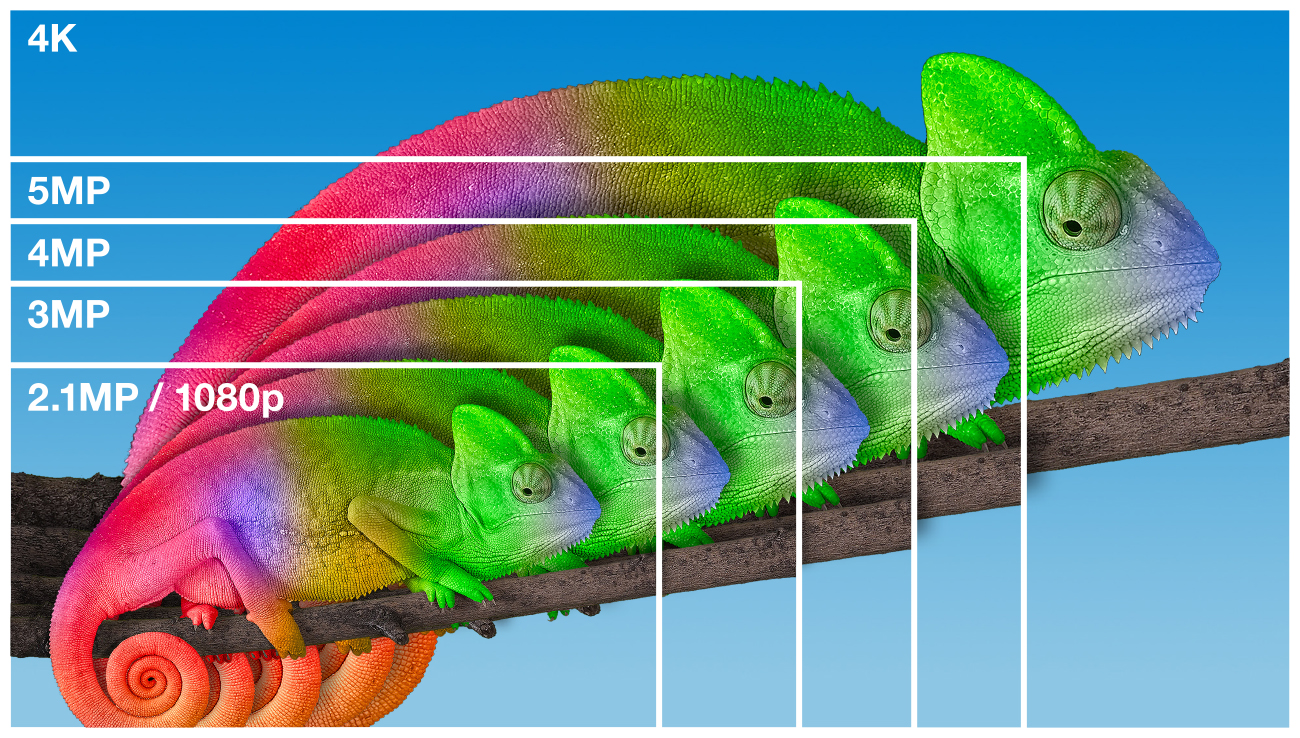



Choose the best camera resolution for the specific need. |
Introduction When shopping for a security camera system, one of the first specifications you'll encounter is resolution. Manufacturers often advertise cameras as 1080p, 4MP, 5MP, 4K, or even higher. While higher resolution generally means more image detail, selecting the right resolution isn't always as simple as choosing the biggest number. The best resolution depends on your security goals, the environment being monitored, storage requirements, and your budget. Understanding how resolution impacts image quality can help organizations make informed decisions that maximize both performance and value. What Does Resolution Mean? Resolution refers to the number of pixels that make up an image. More pixels generally result in greater detail and sharper images. Common surveillance camera resolutions include:
Higher-resolution cameras capture more information, making it easier to zoom into recorded footage and identify important details. Why Resolution Matters Resolution directly affects your ability to:
A camera that provides excellent general awareness may not provide enough detail to identify a suspect. Similarly, a camera capable of facial recognition may be unnecessary for monitoring a warehouse aisle. The key is matching resolution to the intended use. When 1080p Is Sufficient 1080p cameras remain widely used throughout the industry. Advantages include:
1080p is often suitable for:
However, organizations seeking detailed identification may find higher resolutions more effective. Benefits of 4MP and 5MP Cameras Many businesses consider 4MP and 5MP cameras the ideal balance between image quality and efficiency. These cameras provide:
They often serve as a practical middle ground between traditional HD and 4K deployments. Why Businesses Are Moving Toward 4K 4K cameras provide approximately four times the detail of 1080p cameras. Benefits include:
A single 4K camera may cover areas that previously required multiple lower-resolution cameras. For organizations protecting high-value assets, 4K frequently delivers substantial operational advantages. Resolution Isn't Everything Many buyers focus exclusively on megapixels while overlooking equally important factors. Image quality is influenced by:
A poorly positioned 4K camera may perform worse than a properly installed 5MP camera. Understanding Storage Impacts Higher resolutions generate larger video files. This affects:
Organizations should balance image quality with storage efficiency. Modern compression technologies help reduce these impacts, but storage planning remains an important part of system design. Matching Resolution to Use Cases General Monitoring Recommended:
Facial Identification Recommended:
License Plate Recognition Recommended:
Large Parking Lots Recommended:
Warehouses Recommended:
Retail Environments Recommended:
Future-Proofing Your Investment Security systems often remain in service for five to ten years or longer. Choosing slightly higher resolution today may:
As AI-powered analytics continue to evolve, higher-quality video often produces more accurate results. Conclusion The best camera resolution depends on the specific objectives of your organization. While higher resolution provides greater detail, successful deployments balance image quality, storage efficiency, and operational requirements. How Digital Watchdog Can Help Digital Watchdog offers a comprehensive range of MEGApix cameras designed to meet virtually any resolution requirement. From cost-effective HD cameras to advanced 4K or multi-sensor cameras and AI-enabled solutions, organizations can select the optimal camera for each environment. Combined with DW Spectrum VSaaS, Blackjack servers, and cloud-connected management tools, Digital Watchdog helps organizations maximize image quality while maintaining efficient storage and system performance. The best resolution isn't necessarily the highest resolution—it's the one that delivers the information your organization needs when it matters most. |